Acidity (2005)
5th full-length studio album

Release Dates (original)
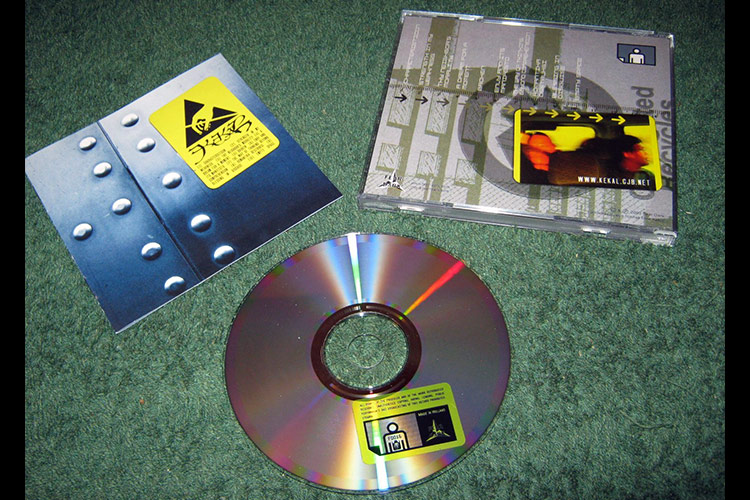
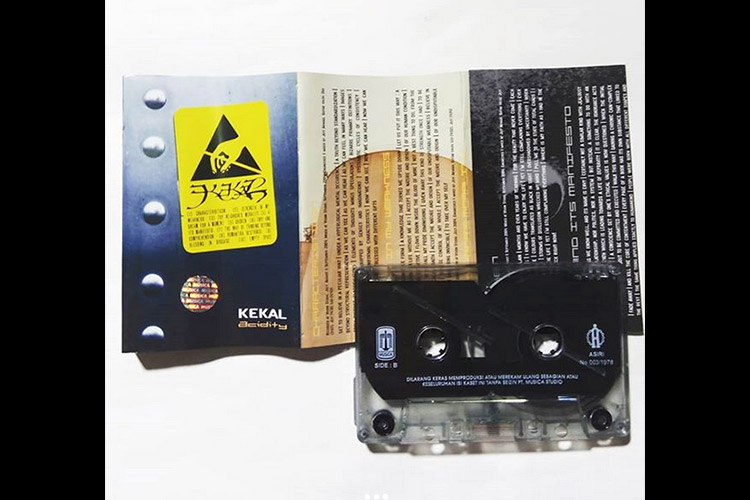
THT Productions/T.O.P., February 2005 (Cassette, Digital)
Fear Dark, May 2005 (CD, Digital)
Release Dates (remastered & updated versions)
Kekal, 2014 (Digital - remastered)
Kekal, 2021 (Digital - remastered)
Kekal, August 2025 (Digital - Updated Edition)
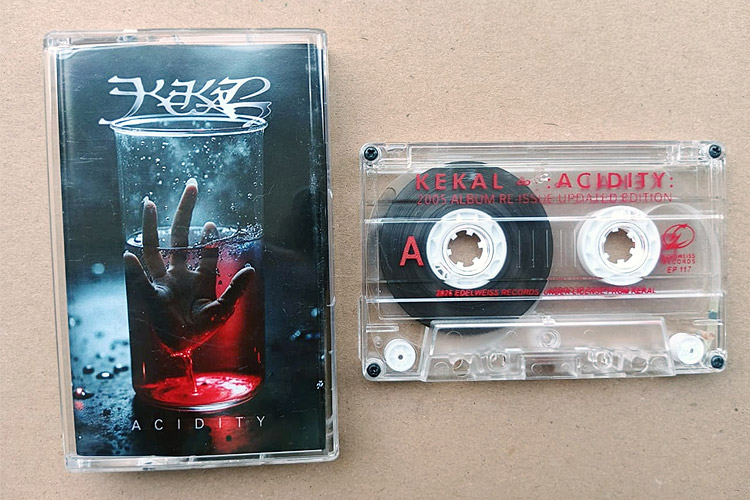
Edelweiss Records, May 2026 (Cassette - Updated Edition)
Track Listing
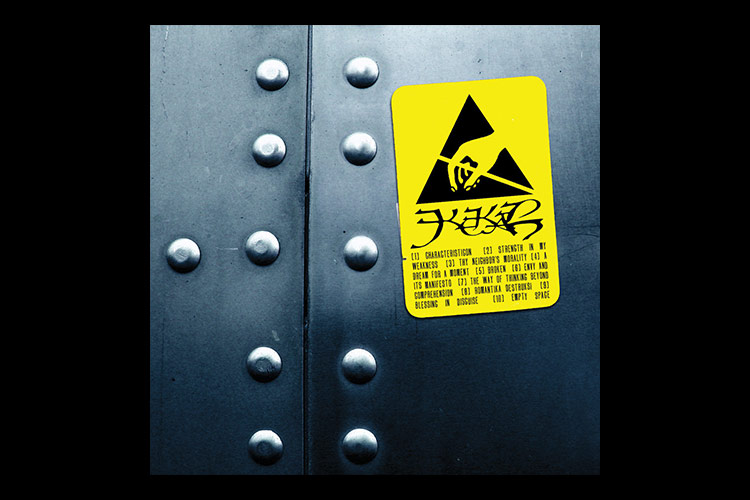
- Characteristicon
- Strength in My Weakness
- Thy Neighbor's Morality
- A Dream for A Moment
- Broken
- Envy and Its Manifesto
- The Way of Thinking Beyond Comprehension
- Romanitika Destruksi
- Blessing in Disguise
- Empty Space
Total Running Time: 56:06
Album Description
Kekal's 5th full-length album has been one of the band's most highly-acclaimed albums. Following a successful European tour in 2004, Kekal returned to their hometown to record this album. Influenced by the raw energy they presented while playing live, it was decided that the recording would get more "live-feel" settings to capture the energy, with rhythm guitars being performed while standing up without using headphones, and tracks were unedited with no “punch-ins” and copy-paste. Musically, it emphasizes on melody lines and guitar solos. "Acidity" is the band's second most selling album after 2003's "1000 Thoughts Of Violence", and got similar high-ratings from media reviews as well as overall listeners' reception.
Originally released in 2005, "Acidity" served as another milestone for Kekal; a transition between the extreme-metal territory they had already roamed about since the mid 1990s and the more avant-garde & experimental direction they were heading at that time. A unique and diverse Kekal album, with many different emotions and thoughts displayed both in the music and lyrics. It presents itself like a caleidoscope, with every individual song cannot represent the whole album but it stands as a part of the album's general concept. Former members of Kekal (at that time) also contributed in the recording, making "Acidity" to be the first official reunion album for Kekal.
Release Note
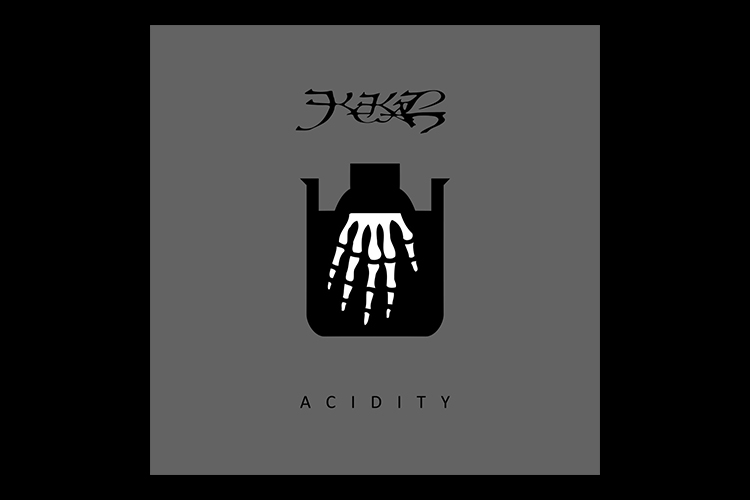
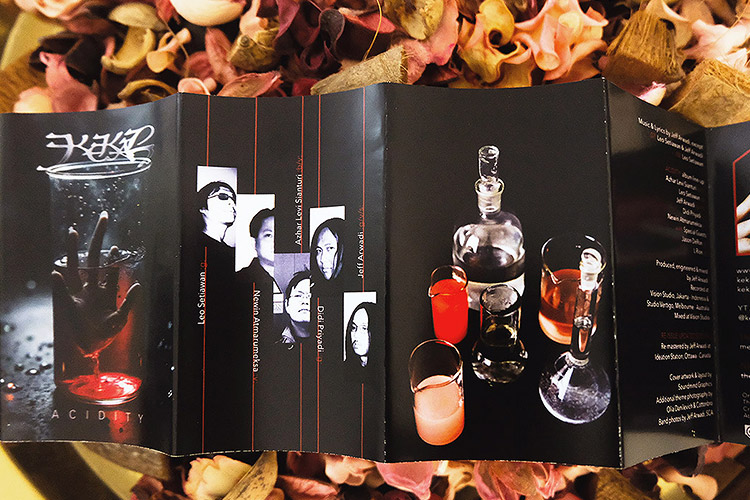
The original 2005 releases (CD and cassette tape formats) are sold-out. Digital version was first re-mastered and re-issued in 2014. It also has a different front cover artwork. The second re-mastered version was done in 2021. The 2021 re-mastered version uses different mix in some of the songs compared to the original version and its multi-layered details are enhanced. It has more balanced and overall warmer sounds with less loudness and less compressed than both the original 2005 version and the 2014 re-mastered version. 2025 Updated Edition features a completely refreshed album cover artwork, including the new 12-page booklet.
Credits
Kekal Acidity album line-up:
Jeff Arwadi: guitars/vocals/programming
Azhar Levi Sianturi: bass/vocals
Leo Setiawan: guitars
Newin Atmarumeksa: vocals
Didi Priyadi: guitars
With special guests:
Jason DeRon: guitar
L Rion: drums
Music & Lyrics by Jeff Arwadi, except
"The Way of Thinking Beyond Comprehension" by Leo Setiawan & Jeff Arwadi
"Romantika Destruksi" by Leo Setiawan
Produced, engineered, and mixed by Jeff Arwadi
Recorded at Vision Studio, Jakarta - Indonesia & Studio Vertigo, Melbourne - Australia. Mixed at Vision Studio
2025 Updated Edition
Re-mastered by Jeff Arwadi at Ideation Station
Cover artwork and layout by Soundmind Graphics
Additional theme photography by Olia Danilevich & Cottonbro
Band photos by Kim R, Jeff Arwadi, SCA
Bonus Tracks:
The Prow (Voivod cover) - Digital Download & Cassette Tape formats
Juices Like Wine (Celtic Frost cover) - Digital Download only
Downloading / Purchasing Information
Acidity Digital Album - Download + Streaming
Direct from Kekal @ Bandcamp (2025 Updated Edition).
This version includes 2 bonus hidden tracks and a 12-page PDF digital booklet with refreshed artwork. Free Download available under "Name Your Price" scheme. All of the files you download on Bandcamp are 100% DRM-free.You can also add the album to your Bandcamp collection for unlimited streaming on Bandcamp app. Download free Bandcamp app here: Android | IOS.
Important Notice about Mainstream Streaming Platforms
A decision has been made that Kekal will NO LONGER distribute any of its new and upcoming music on the mainstream digital streaming platforms (Spotify, Apple Music/iTunes, YouTube Music, Amazon Digital, etc.). Music/Lyric Videos and official audio will continue to be posted on Kekal's Official YouTube channel by Kekal, and not through the YouTube Music digital distribution system.
Buy Acidity Physical
Original Used CD and Cassette (sold by online re-sellers) on Discogs site.
Note: The original CD and Cassette Tape versions are now out-of-print and has already been sold-out at official stores/distributors, but if you are into collecting out-of-print physical releases, you may still get the used and even unplayed copies sold online via Discogs site. See from the list of resellers here. They accept PayPal for international orders.
Limited Cassette Tape - 2025 Updated Edition.
Released by Indonesian label Edelweiss Records. Order Info, please contact the label directly via Bandcamp. Click the link above. International resellers/mailorders are welcome! Please inquire the label directly about the details. This version is not sold or handled by the band.
**NEW**: Acidity Merchandise
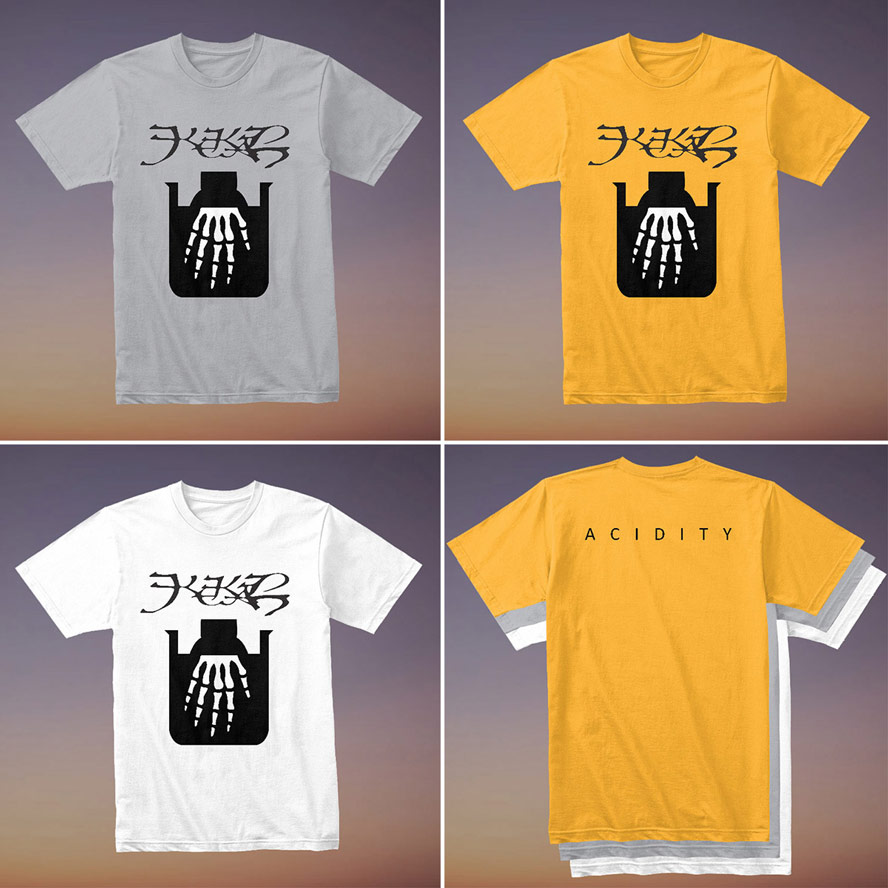
Official T-Shirt designs for Acidity. 2 options available. Choose between cover artwork of the album's 2025 Updated Edition or the simple Acidity symbol from the previous version. DTG Printing. Printed and fulfilled by TeePublic. Check if shipping is available to your country. Kekal merchandise is officially managed by Spitonself Music.
Music Video + Audio Streaming
Insight - Q&A with Jeff #1, May 2026
(Excerpt of 2026 Interview on Africa.Rocks - See Full Interview Here)
Q: "Acidity" is coming back twenty years after its original release. When you listen to that album now, what still feels close to the original idea of Kekal, and what feels like it belongs to a very different time in your life?
I consider "Acidity" a unique album, comparable to a kaleidoscope or a mosaic in a musical sense. It was originally made to represent the first ten years of the band back in 2005. So, alongside the newly written songs at that time, other songs were also picked from the archive of our personal songs, demoed from as early as 1996 to 2001. I see myself as a singer-songwriter type of musician, so in the past I would write and demo or record my own songs. Some of these songs could not really fit into an extreme metal music body, so they were not used in Kekal’s earlier work. But when we decided to do the "Acidity" album, we had already been known as an experimentally inclined, progressive or avant-garde band from the previous two albums, so that was the time I decided to bring some of my older songs and rearrange them into the Kekal framework. Musically, "Acidity" made or pushed Kekal to expand itself into new territories the band had yet to explore, so it was an exciting and diverse album. It is still very much Kekal, and it sounds very authentic in the sense that the music itself was made from the heart, from the inside out. Many reviewers said that the music is uniquely Kekal, and they could not compare it to other bands for similarities. The original idea of Kekal is that, as a band, we always refuse to compromise. Looking back, the main difference between "Acidity" and our more recent albums is that the band members at that time were still able to play together and jam. There are certain aspects of music that can only be achieved through jamming. So yes, you can say this album belongs to a different time in the band just because of how it was constructed.
Q: The updated edition has remastered audio and completely new artwork. What did you want to correct, preserve or reframe without turning the record into something else?
I have to admit, the original album cover artwork of Acidity was actually one of the weakest artworks of Kekal, as it does not quite represent the music. Our bass player at that time, Levi, who later on would provide the illustration or photography for the band's album artworks, had not yet supplied any illustration work for Kekal. At the same time, I was quite adamant about maintaining the strict do-it-yourself attitude of Kekal, without paying more attention to the artistic and visual concept of the album. The record label in Europe who worked with us at that time, Fear Dark, actually offered us artwork from Kris Verwimp for this album, because they had worked with him for a number of other bands in the label’s roster, but we declined because we wanted the album to have the same artwork as the Indonesian version, which had already been printed and scheduled for release.
The need was to provide an eye-catching album cover for the Indonesian market, because the album was distributed at mainstream retail record stores, and I did not want to give the impression of Kekal being just another typical extreme metal band by having typical album artwork. I wanted to give an enigmatic impression to anyone who had not yet heard our music. Remember, the album was originally released in 2005, so it was before YouTube and the rest of the online digital platforms, even before MySpace became a short hit. A significant number of potential listeners would buy an album without hearing the music beforehand, so they would just pick almost randomly from the shelves by looking at the artwork. The updated edition was mostly done to correct the artwork side of it, to make it more representative of the music. The audio also got a refresh from the remastering, using a more up-to-date M/S, or mid-side, digital treatment and toning down the loudness and compression a bit to give it some breathing space. I think the album has achieved its objective right now, and it is still enjoyable and relevant even after 20 years. I encourage anyone to download the album. It is set as name-your-price on Bandcamp. For record collectors, there is also a limited-edition cassette tape format being released this month, May 2026, by Indonesian label Edelweiss Records.
Q: "Acidity" followed "1000 Thoughts Of Violence", the album that pushed Kekal further into progressive, avant-garde and experimental metal. How did "Acidity" expand that path in its own way?
Everything started from the European tour back in early 2004. Something quite unprecedented happened only about a week before we were supposed to fly to Europe to start the tour. Our other guitarist, Leo, could not get the visa, so he was unable to join us. Kekal’s music typically requires two guitarists playing different roles at the same time. When we found out he could not join, I had to rearrange the guitar parts and also the overall approach so that it could be played by one guitar only, with bass covering some of the parts needed. So we decided to play it raw and focus more on the energy, like punk music, as opposed to recreating all the details presented in the album, because it was impossible to do that with only one guitar. But it turned out pretty well. The audience could feel the raw energy.
That tour was an important milestone for us because, at that time, we were the first Indonesian band to tour Europe. It also helped Kekal become more visible in Indonesia, with major radio stations starting to play our songs and coverage from local mainstream magazines as well. That was the first time we produced our first single, "A Dream For A Moment", backed by a music video to promote the then upcoming album "Acidity" in early 2005, which would be sent to local Indonesian radio stations, although only a handful ended up picking it because the song exceeded the five-minute limit.
"Acidity" was the album where we had already secured everything: a label in Europe with relatively good distribution and decent promotion, and also a major distribution package in Indonesia, even if only for a one-year period. It was the time we thought about taking risks in expanding the musical side of it. So, when we began to record "Acidity" in 2004 after finishing the tour, it was decided that we would do the recording more in a live setting to capture all the raw energy. We recorded all the rhythm guitars while standing up, without using any headphones, and also without editing or punch-ins. If we made tiny mistakes, we would leave them unedited.
"1000 Thoughts Of Violence" achieved its own objectives and, up to this date, it is still the most popular Kekal album. But compared to "Acidity", that album feels a bit clinical and mechanical, the traits most commonly found in extreme metal. Acidity has more of an organic and spontaneous rock feel to it, where listeners can jump around and imagine it as something like a heavier version of Van Halen, minus the Van Halen musical skills. In "Acidity", I began to work my guitar solos in a much more spontaneous and improvised way. I would do three improvised takes, and then just take the most interesting parts from the three and arrange them into one whole solo section. You can achieve much better results that way than by preparing them beforehand and then playing them over and over again during recording just because you miss some notes. That can drain your raw energy.
Thanks to the method used in recording "Acidity", right now I feel comfortable exploring the unknown through spontaneous improvisations. But in order to explore the unknown, I needed to be completely free from anything that would hinder me, including thoughts of what the music should sound like in the first place. You do not need to have a preconceived idea of everything. You can just be in the present moment, almost like a child playing with something out of pure curiosity and letting his imagination run wild. It is the same thing when you play around with a guitar, for example. You can just do whatever you wish with it while it is recording. You may create the most interesting chord progression or riff, or whatever, without knowing it beforehand.
Read the rest of the interview here
Insights - Q&A with Jeff #2
February 2012 and March 2005
(from the February 2012 interview)
"Acidity" is a very unique guitar oriented album, what was in your mind when starting to write the music for the album, knowing that you must have been 'haunted' by "1000 Thoughts of Violence" as it was your most successful album at that time? Were you afraid that the material would not meet the same level of excellence as the previous album?
I remember telling the guys from Fear Dark label during the European tour, that the next album would not be part 2 of "1000 Thoughts of Violence." No matter how successful "1000 Thoughts..." was in album sales at that time, it was just the right album at the right time, and 2005 will not be the right time again. In other words, I wanted "Acidity" to be different and have its own character, and I hoped people wouldn't expect it to be another "1000 Thoughts of Violence" or compare it to that album. Many of the songs on "Acidity" are recycled from earlier demo songs, even as early as 1996, because we wanted it to be some sort of a '10th anniversary reunion' album, so it should be a little kaleidoscopic, one song can get you into one era of Kekal and so on. And all the rhythm guitars were recorded live while standing up, using monitor speakers with no headphones on and with no overdubs or editing at all, even to the sound, to give it more of a live album feel, as opposed to the more processed, clinical feel of "1000 Thoughts...". I was worried a little, yes, because I knew that the record label would set higher expectations for the album after "1000 Thoughts...", and that the album sales might not meet their expectations. The album isn't selling as well as "1000 Thoughts...", but it gained very positive reviews, so the label was pretty happy about it.
On track #1, "Characteristicon", there are 2 versions, one with clean vocals on the Indonesian release, and the other one with the harsh, black metal vocals on the international release. Any reason why there are 2 versions of the same song?
Originally, the one with clean vocals was the final mix for all versions, and it was already mastered for the Indonesian release. But when the guys from Fear Dark (the record label from The Netherlands) listened to it, they didn't quite like it. They prefer the opening song to have raspy and screech-y vocals, as a first impression that "this is still a heavy, extreme metal album with blast beats and all that stuff". I don't mind with both versions, I agree that "Characteristicon" is a heavy song and perfect for the opening for the album. So I just re-did the vocals for the Fear Dark version. The Indonesian version had already been released by the time I was recording the one with raspy vocals.
(from the March 2005 interview)
What is the meaning behind the album title "Acidity", if there are any?
It is related to "urban stress" created by our urban lifestyles and the way we work every day. The term "Acidity" is actually a medical term, and it is a state when your stomach produces acid at an excessive level. When you are at a highly stressed level (the stress level which most who live and work in a huge city like Jakarta have), your stomach tends to produce a high amount of acid. That's why you always feel hungry when you're stressed. Also, if you eat fast-food, the chemicals in there can make your stomach produce an excessive amount of acid. So, the more stress you have and doubling the heavy consumption of fast-food can make the acidity level be very high, it could even be deadly. Ironically, our urban lifestyles leave no other options. It's killing you softly. You will face daily job stress each day, and you can only eat at fast-food stores because you have a short lunchtime and an almost empty pocket.
I've noticed some changes in the production of Acidity, one example is the drum sound. The new album has the snare sounds louder and it is set in a higher pitch, also the kick drums lack some accentuation. Is that because you used the real drums, or because you guys decided to make exactly what it is as a part of the album concept?
All the drum production is intended as a part of the whole production for the album. You can hear the different mixes on bass and guitars too, right? If you ask me for the reason. The main thing is because we wanted to sound more "rock" and "groovy" again. As you know, on our previous album "1000 Thoughts of Violence", we wanted to get all those dark sounds, so I brought in the kick drums up in the mix to the level that you cannot really feel the groove of the songs. The bass guitar mixed quite low and distorted a lot on "1000 Thoughts..." because that's a good way to get the eerie feel of the song, I had to make some hollow at the middle-low frequencies, and you could feel the sound reflecting the emptiness in your heart. But on "Acidity", we didn't want to make a whole dark album, so we changed back to general production like our first album "Beyond The Glimpse of Dreams", while the snare drums should sound more "alive" and the bass-drums kept at a low frequency and aren't very "clicking". And the bass guitar sounds more "in-your-face" as you can hear all the basslines. This is the ideal "rock" mix, I guess, the best way for us to get a good groove.
Now switch to guitar.... You used a Floyd Rose or up-down bridge system for your guitars, how do you feel about playing with that kind of bridge? Do you think it is necessary for your type of guitar playing?
I started to play electric guitar in 1989. Before I had my own guitar, I tried some guitars at the rehearsal studio, from Strat, Telecaster, some Gibsons, but I never thought they were cool enough until I found a "metal" guitar with double humbuckers and Floyd Rose system on it. I just thought "Wow, it looks great, it looks real metal." I couldn't play guitar in 1989 so my impression was entirely based on the look rather than sound, you know. When I got a chance to get my own guitar a couple years later, I chose the one with humbucker pickups and Floyd Rose tremolo bridge. And then I developed my playing from that guitar. I don't think the Floyd Rose system is good enough to maintain the tuning. If you use it too much, like playing some evil screamin' metal solos, you will need to tune your strings again. It's not very recommended for live shows unless you bring more than 1 guitar and have your own guitar technician.
You used a lot of guitar solos (played by 4 guitarists) in "Acidity". It will be considered "too much" by modern metal producers and music critics. Do you think that KEKAL will get criticized as "metal band of the past" instead of "metal band of the future" because they use so many solo guitars?
We have been criticized by a few reviewers for doing too much of everything. You know, too much experimentation, too many non-metal elements, too complex, too much electronic parts, etc.. But, yet people see KEKAL as a unique band because of all of these "too much" aspects of our music. We never follow trends, so when we use something in our music, we never consider using it based on current trends in music. We just do it because we love to do it. People can love or hate our music. I don't care, they have a lot of things in this world to choose from. Until today, I haven't read any review that says that we use "too much" solo guitars on "Acidity". I'm still waiting to hear all their opinions on the future reviews.
I always see metal music more as "entertainment" rather than "art". People come to metal shows to get themselves headbanged, moshing, slamming, stage-diving, and having fun with their body movements. It is more similar to dance/house/rave music or hip-hop. The presentation of "art" in most metal bands is very different from the presentation of art in industrial/noise bands. Some metal bands utilize theatrical performances and sometimes happening art, but the response in the audience are different. As a metal musician, where do you think you stand between "art" and "entertainment"? And do you think metal music limits your freedom to express yourself?
To me, art itself always has an aspect of entertainment in it. It has never been like "art" versus "entertainment." They actually walk hand-in-hand. "Entertainment" is a very common term. "To get pleased with", is a synonym of "to get entertained with". If something pleases you, you can also say that it entertains you. Whether an art is entertaining or not only depends on the impact on people, but how many people? That's the case. The definition of "entertainment" for today's society is when something is appealing to the masses, to a large number of people, to society in general. A piece of art, like a painting or a song, sometimes only pleases very few people, sometimes only pleases the one who made it and no one else. It is an entertainment, but not yet statistically enough to be labeled "entertainment", because only very few people can be pleased with it.
I think KEKAL music should please us. If not, we wouldn't record it anyway.. Haha.. But is our music entertaining enough for today's standard of "entertainment"? I cannot say, because if we use today's standard, I don't think KEKAL music can appeal to so many people and can please the masses. But I wouldn't say that I don't want my music to be entertaining, because it does entertain. I don't think metal music limits my freedom to express myself, as long as I don't get stuck with its tradition and "rules".. I don't care whether people consider our music as metal or not.. And I don't care if the audience would get themselves headbanged or moshing to our music, or just stand up, sit down, sleep, whatever.
I don't really get into headbanging on stage myself when playing music. Sometimes I do a little, but it's just for counting the beat, you know. And we don't interact too much with the audience during our set. That's our own expression. Typical metal bands shout to the audience like; "How are you people, are you hot yet? Now we'll make you hotter than hell." as you might expect from a rock n' roll band playing at prom night. But we're just playing our music and that's all. We don't follow the rules and tradition in heavy metal. We're musical anarchists. I have enough freedom to be myself when I write music as when I'm on the stage, even though we play metal music.
Related Albums
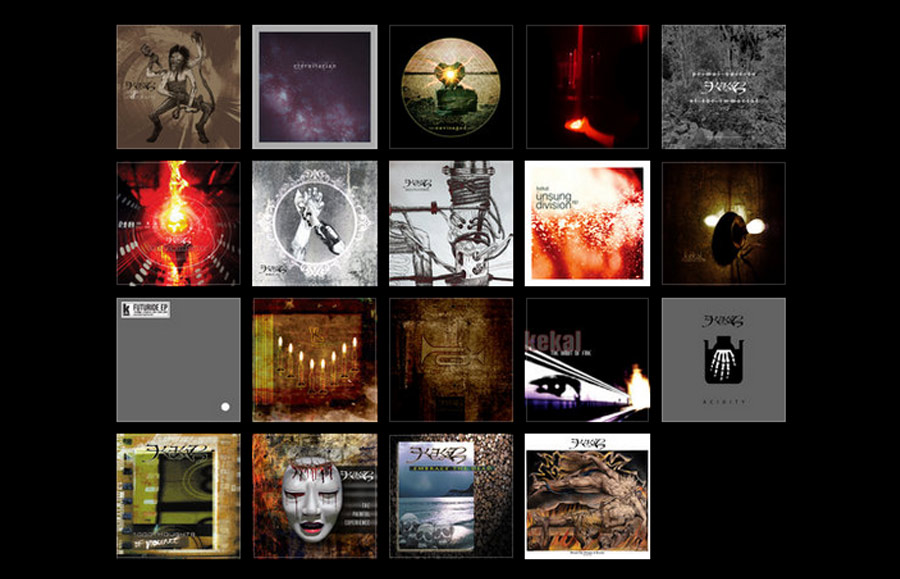
Get All Kekal Digital Releases
Get the entire Kekal digital album discography (a bundle of 19 Kekal digital releases sold on Bandcamp including 13 full-length albums and 4 EPs) for only $29 USD. That's a 50% off a-la carte price.
A great way to check out the music of Kekal.